
PathwayFinder enables linked exploration of cell types and gene modules in spatially resolved transcriptomics data
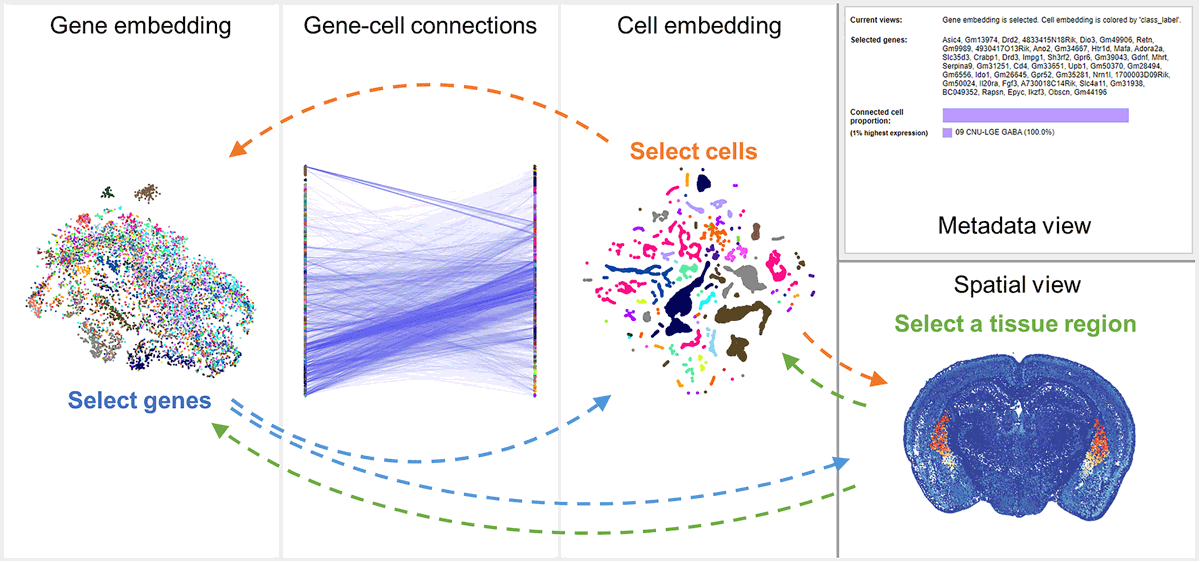
The rapid development of spatially resolved transcriptomics technologies has provided opportunities and challenges for understanding biological systems. Interpreting these data requires integrated analysis of gene expression and cell types within their spatial context, however, existing tools fall short in scaling this linked interactive exploration to large-scale datasets. We present PathwayFinder, a visual analytics application designed to bridge the gap between gene-centric and cell-centric analysis. Unlike standard workflows that view cells and genes in isolation, PathwayFinder links them through a multi-scale interactive interface. This allows researchers to explore the relationships between transcriptomic profiles and tissue architecture, for example, by selecting a cell type to instantly discover its potential marker genes, or brushing gene modules to identify cell populations expressing them and their spatial distributions. Through this tight integration of gene, cell, and spatial views, PathwayFinder facilitates rapid discovery of co-expressed gene modules, specialized cell subpopulations, and functional hypotheses in spatial contexts.
Resources
Citation
BibTeX
@article{ bib:2026_pathwayfinder,
    author = {Chang Li and Julian Thijssen and Thomas Kroes and Lisa Koorneef and Thomas H{\"o}llt and Louise van der Weerd and Boudewijn Lelieveldt},
    title = { PathwayFinder enables linked exploration of cell types and gene modules in spatially resolved transcriptomics data },
    journal = { iScience },
    volume = { 29 },
    number = { 11 },
    pages = { 118043 },
    year = { 2026 },
    doi = { 10.1016/j.isci.2026.118043 },
}